<?php
Step1:
// Lets parse some xml data
$data = '<?xml version="1.0"?>
<organization><employees><employee><id>1</id><name>JohnChow</name><age>25</age></employee><employee><id>2</id><name>Simon</name><age>19</age></employee></employees></organization>';
$xml = simplexml_load_string($data);
$response_arr = array();
foreach ($xml->xpath('//employee') as $ch)
{
$employee_id = $ch->id;
$response_arr[(string)$employee_id]=array('id'=>(string)$employee_id,'name'=>(string)$ch->name,'age'=>(string)$ch->age);
}
print_r($response_arr);
Step2:
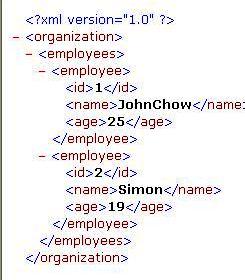
Now lets parse an xml file (with same data as above)
The xml file is shown below as a reference:
$file = 'sample.xml';
$xml = simplexml_load_file($file);
$response_arr = array();
foreach ($xml->xpath('//employee') as $ch)
{
$employee_id = $ch->id;
$response_arr[(string)$employee_id]=array('id'=>(string)$employee_id,'name'=>(string)$ch->name,'age'=>(string)$ch->age);
}
print_r($response_arr);
?>
In both cases, we get the same output in array format, as shown below:

Step1:
// Lets parse some xml data
$data = '<?xml version="1.0"?>
<organization><employees><employee><id>1</id><name>JohnChow</name><age>25</age></employee><employee><id>2</id><name>Simon</name><age>19</age></employee></employees></organization>';
$xml = simplexml_load_string($data);
$response_arr = array();
foreach ($xml->xpath('//employee') as $ch)
{
$employee_id = $ch->id;
$response_arr[(string)$employee_id]=array('id'=>(string)$employee_id,'name'=>(string)$ch->name,'age'=>(string)$ch->age);
}
print_r($response_arr);
Step2:
Now lets parse an xml file (with same data as above)
The xml file is shown below as a reference:
$file = 'sample.xml';
$xml = simplexml_load_file($file);
$response_arr = array();
foreach ($xml->xpath('//employee') as $ch)
{
$employee_id = $ch->id;
$response_arr[(string)$employee_id]=array('id'=>(string)$employee_id,'name'=>(string)$ch->name,'age'=>(string)$ch->age);
}
print_r($response_arr);
?>
In both cases, we get the same output in array format, as shown below:

Comments
Post a Comment